
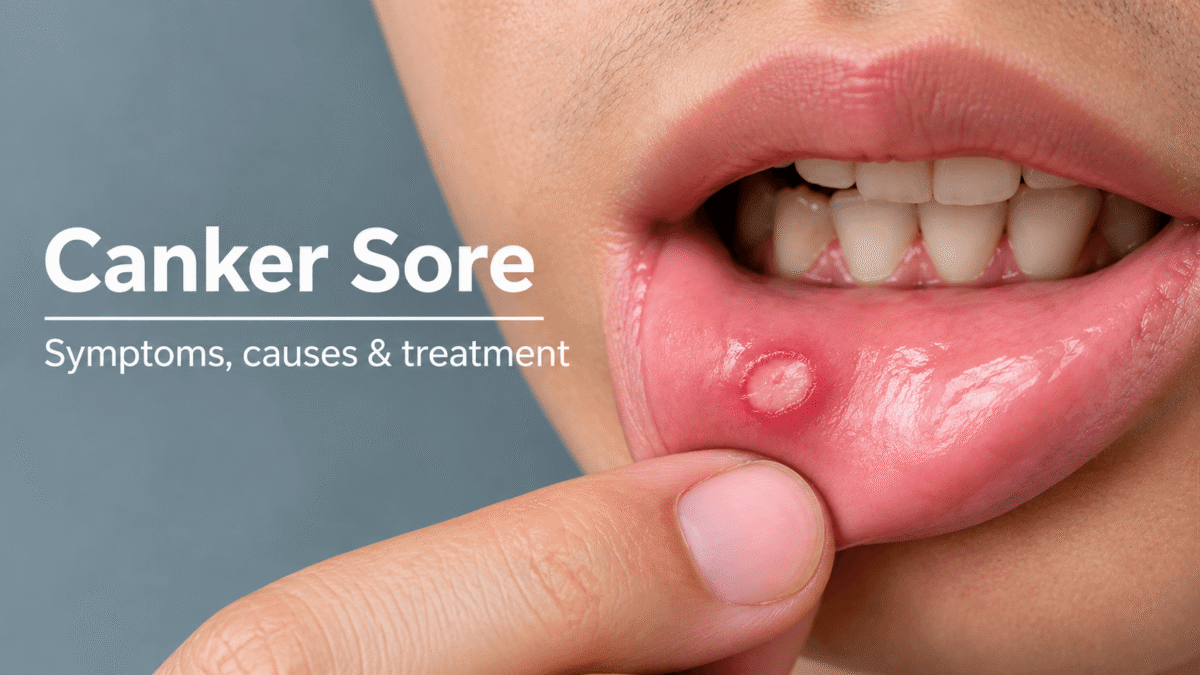
Canker sores are a common oral health concern, affecting up to 25% of the worldwide population. If you have spotted a small white or yellow sore inside your cheek, lip, or mouth, you may have experienced one yourself.
Medically known as aphthous ulcers, canker sores are small, shallow sores that develop on the soft tissues inside the mouth. They can make eating, drinking, brushing, or talking uncomfortable, but most are harmless, not contagious, and unrelated to the herpes virus. Minor canker sores typically heal on their own within one to two weeks.
Understanding what causes them and how they heal can make them easier to manage. This guide covers their symptoms, causes, treatment options, and when to see your dentist.
What Is a Canker Sore?
A canker sore, also called an aphthous ulcer, is a small round or oval sore that forms on the soft tissue inside your mouth. It usually has a white or yellow center with a clearly defined red border. Canker sores form on the inside of your cheeks or lips, on or under your tongue, at the base of your gums, or on the soft roof of your mouth.
Canker sores are not the same as cold sores. The herpes simplex virus causes a cold sore, which forms on the outside of your lip and is contagious. A canker sore forms only inside your mouth, has no known viral cause, and cannot be spread to another person through a kiss, a shared drink, or any other contact.
What Does a Canker Sore Look Like?
A canker sore starts as a small red or slightly swollen spot before it opens into a shallow ulcer. Once it forms, it typically has a white or pale yellow center surrounded by a red, inflamed border. There are three recognized types, and knowing which one you are dealing with helps set the right expectations for healing time.
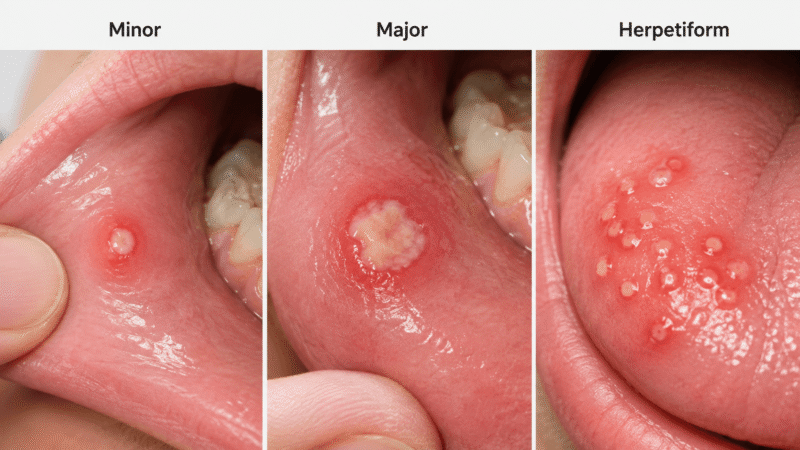
| Type | What You Will See | Typical Size | Healing Time |
|---|---|---|---|
| Minor canker sore | Small, oval, well-defined red border | Under half an inch | 7 to 14 days, no scarring |
| Major canker sore | Larger, deeper, edges may look uneven when big | Half an inch or larger | Up to 6 weeks, can leave a scar |
| Herpetiform canker sore | Many tiny pinpoint sores clustered together, may merge | Pinhead-sized, in groups of 10 to 100 | 7 to 14 days, no scarring |
Canker Sore Healing Stages
A canker sore moves through a fairly predictable pattern from the moment you first feel it to the day it disappears. Knowing what is normal at each stage helps you tell the difference between a sore that is healing on schedule and one that needs professional attention.
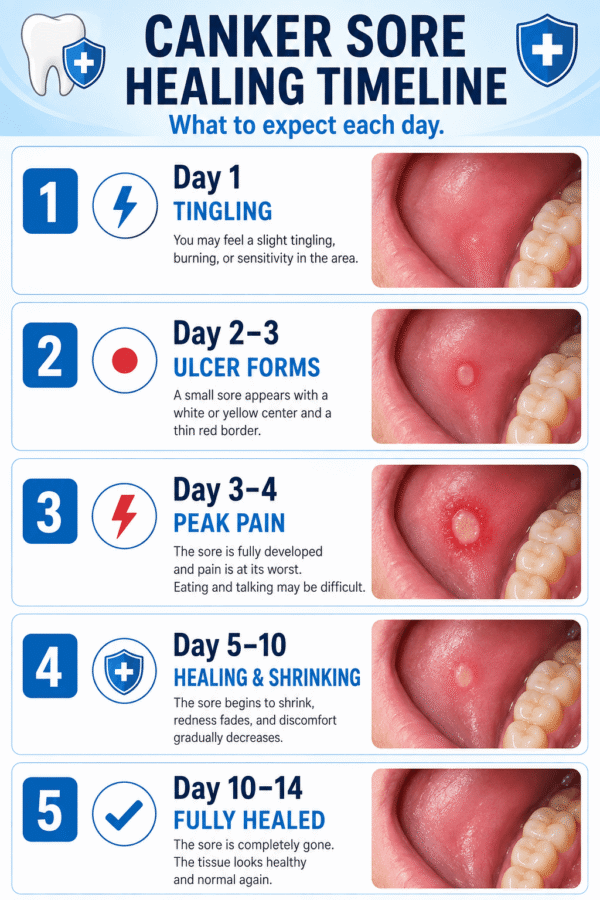
| Stage | What Happens |
|---|---|
| Day 1 | A tingling or burning feeling appears before you can see anything |
| Day 2 to 3 | A small red bump forms and then opens into a shallow ulcer with a white or yellow center |
| Day 3 to 4 | Pain usually peaks; eating and talking may feel uncomfortable |
| Day 5 to 10 | The sore begins to shrink, and the surrounding redness fades |
| Day 10 to 14 | The tissue closes over completely, and the area returns to normal |
If your sore is not following this pattern, for example, it keeps growing after day 4 or shows no sign of shrinking by day 10, that is a signal worth paying attention to rather than a reason to worry immediately.
Where Do Canker Sores Form?
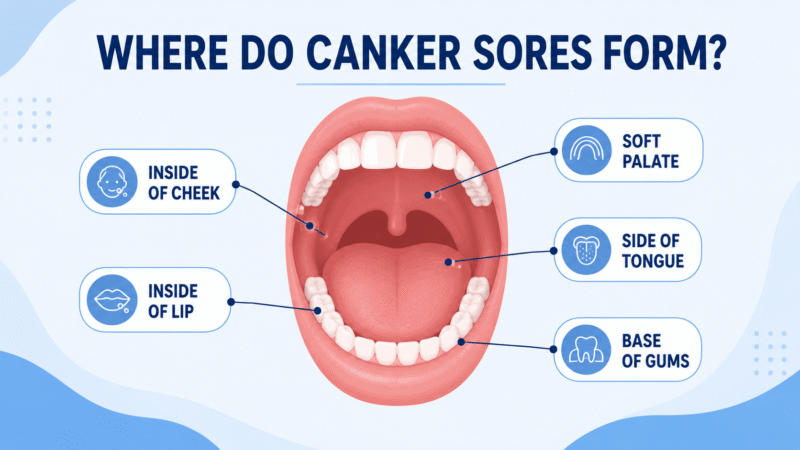
Canker sores only form on the soft, movable tissue inside your mouth, not on the outer skin of your lips and not in your throat. Here is where they actually show up.
| Location | How Common |
|---|---|
| Inside the cheeks | Very common |
| Inside the lips | Very common |
| Under or on the sides of the tongue | Common |
| Base of the gums | Common |
| Soft palate, the back part of the roof of your mouth | Less common |
What Are the Symptoms of a Canker Sore?
Most people notice a canker sore before they ever see it. Common symptoms include:
- A tingling or burning feeling a day or two before the sore appears
- A small, round or oval sore with a white or yellow center and red border
- Pain that gets worse when eating spicy, salty, or acidic foods
- Mild swelling in the surrounding tissue
- Discomfort while talking, brushing your teeth, or wearing braces or a denture
Canker sores do not usually cause fever, and a single sore rarely causes swelling that spreads beyond the immediate area. If either of those happens, it points toward something other than an ordinary canker sore.
What Causes Canker Sores?
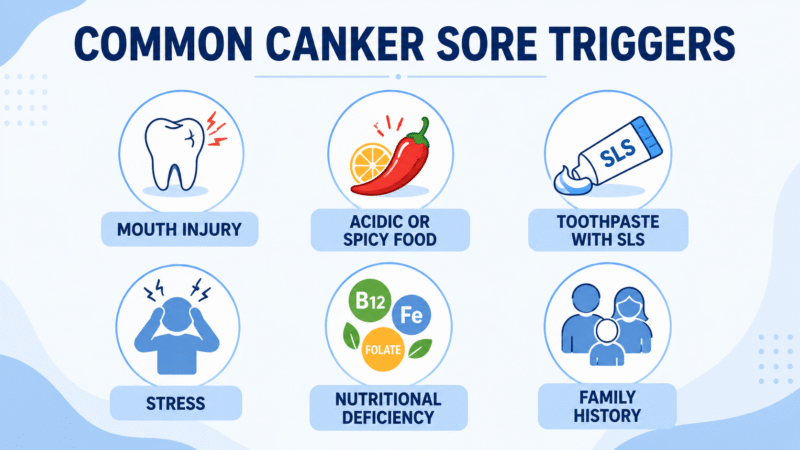
The exact cause is not fully understood, but researchers have identified several common triggers and a few underlying conditions that make some people more prone to canker sores than others.
| Category | Examples |
|---|---|
| Mouth injury | Biting your cheek, aggressive brushing, sharp edges on braces or dentures |
| Food triggers | Acidic foods like citrus and tomato, spicy food, chocolate, coffee, nuts |
| Toothpaste and rinses | Products containing sodium lauryl sulfate, a foaming agent |
| Stress and hormones | Emotional stress, hormonal shifts during your menstrual cycle |
| Nutritional deficiencies | Low vitamin B12, iron, folate, or zinc |
| Underlying conditions | Celiac disease, inflammatory bowel disease, a weakened immune system |
Genetics also play a real role. If a parent or sibling often gets canker sores, you are statistically more likely to get them too.
Why Do You Keep Getting Canker Sores?
If you notice a new canker sore every few weeks or have more than one at the same time, that pattern is worth paying attention to on its own, separate from any single sore.
Frequent or recurring canker sores are usually tied to one of a few things: a genetic tendency that runs in your family, a food or product trigger you have not identified yet, ongoing stress, or a nutritional gap such as low B12 or iron.
Getting one canker sore now and then is common and usually not a concern. Getting them constantly, or having several appear at once, is the kind of pattern your dentist can help you actually investigate rather than manage sore by sore.
What Actually Helps a Canker Sore Heal?
Most canker sores heal on their own, but there are proven ways to reduce pain and support healing while that happens. Topical anesthetic gels containing benzocaine or lidocaine, along with alcohol free mouth rinses, are commonly used to ease pain from canker sores.
Steps that genuinely help:
- Switch to a toothpaste that does not contain sodium lauryl sulfate if you suspect it as a trigger
- Use a soft-bristled toothbrush to avoid further irritating the area
- Avoid acidic, spicy, and salty foods until the sore has healed
- Ask your dentist about orthodontic wax if braces or a dental appliance keep rubbing against the sore
- Use an over-the-counter topical gel to numb pain around meals
For larger or unusually painful sores, a dentist can offer options that go beyond what is available on a store shelf, including a prescription strength rinse, a corticosteroid treatment applied directly to the sore, or in-office laser treatment that can noticeably speed healing and reduce pain within a day or two.
If a canker sore is severe enough to affect your eating or sleep, that is a reasonable point to bring it to us at Robison Associates rather than waiting it out.
How Long Does a Canker Sore Last?
A minor canker sore typically heals within 7 to 14 days without any treatment. A major canker sore can take up to 6 weeks and may leave a small scar. Herpetiform canker sores, despite appearing as many small sores at once, usually clear up within the same 7 to 14 day window as minor sores.
Pain from a canker sore usually peaks around day 3 or 4 and then steadily improves, even before the sore itself has fully closed
Canker Sore vs Cold Sore vs Mouth Ulcer vs Abscess
These four are commonly confused with each other, but they behave very differently.
| Feature | Canker Sore | Cold Sore | Traumatic Mouth Ulcer | Dental Abscess |
|---|---|---|---|---|
| Location | Inside the mouth only | Outside the lip | Inside the mouth, usually near the injury | At the root of a tooth or in the gum |
| Contagious | No | Yes | No | No |
| Cause | Unknown, linked to triggers | Herpes simplex virus | Direct injury, such as a bite | Bacterial infection |
| Appearance | White or yellow center, red border | Fluid filled blisters that crust over | Similar to a canker sore, tied to a clear injury | Swelling, often with a pimple like bump on the gum |
| Pain pattern | Painful, improves steadily | Tingles, then blisters, then crusts | Painful at the injury site | Deep, throbbing, may worsen over time |
If a sore comes with a fever, significant facial swelling, or throbbing pain that worsens rather than improves, it may be an abscess rather than a canker sore, and that needs prompt dental attention.
Is It a Canker Sore or Something More Serious?
In the vast majority of cases, a sore that appears and disappears within two weeks is an ordinary canker sore. But it is worth knowing the difference between a canker sore and a sore that needs a closer look, since some early signs of oral cancer can resemble a canker sore at first glance.
| Feature | Canker Sore | Worth a Professional Look |
|---|---|---|
| Heals within 2 weeks | Yes | No |
| Painful | Usually, from the start | Often painless early on |
| Bleeds without being touched | No | Can |
| Borders | Smooth, well defined | Irregular, raised |
| Grows over time | No | Can |
The rule of two weeks makes this simple. If a sore in your mouth has not healed within 14 days, or if it keeps growing instead of shrinking, it is time to have it checked rather than waiting to see what happens.
You can learn more about what to watch for and how screening works on our oral cancer screening page.
When Should You See a Dentist for a Canker Sore?
Most canker sores never need a dental visit. Call your dentist if your sore:
- Has not healed after two weeks
- Is unusually large, larger than about half an inch
- Keeps coming back before the last one has fully healed
- Comes with a fever or swollen lymph nodes
- Makes it hard to eat, drink, or talk
- Spreads onto the outer lip or skin
- Causes pain you cannot manage with an over-the-counter product
None of these signs alone mean something serious is happening. They are simply the point where a professional look is more useful than waiting.
Canker Sore Care at Robison Associates in Colorado Springs, CO
At Robison Associates, we know a painful mouth sore can be distracting enough to interrupt your whole day, and we are always glad to take a look if something does not seem to be healing the way it should. Dr. Letha Robison and our team can quickly tell you whether you are dealing with an ordinary canker sore, something that needs a targeted treatment, or a change worth screening further.
If a sore is unusually painful, unusually large, or simply will not go away, do not wait it out alone.
Schedule a visit and let us take a look, so you can stop guessing and get back to your normal routine.




Leave A Comment
You must be logged in to post a comment.