Quick Summary:
Dental sealants are thin protective coatings applied to molars and premolars to help prevent cavities by blocking bacteria and food particles from settling into deep grooves. Children without sealants are nearly three times more likely to develop cavities. The procedure is quick, painless, non-invasive and usually takes only about five minutes per tooth. Sealants can prevent up to 80% of cavities in back teeth during the first two years and may last 5–10 years with proper care. Both children and adults with cavity-prone teeth can benefit from sealants, and many insurance plans cover them for children.
Tooth decay continues to affect millions of children and adults worldwide. According to the Centers for Disease Control and Prevention (CDC), children aged 6 to 11 years without dental sealants are nearly three times more likely to develop cavities in their molars than children with sealants. These protective dental coatings help block food particles and bacteria from settling into the deep grooves of teeth, significantly reducing the risk of decay.
While sealants on teeth are commonly recommended for children, adults with cavity-prone teeth can also benefit from this preventive treatment. If you are considering dental sealants for yourself or your child, this blog is a complete guide covering the benefits, procedure, cost, and cavity-prevention advantages of dental sealants. Keep reading!
What Are Dental Sealants?
Dental sealants (sometimes called a sealant for teeth, tooth sealants, pit-and-fissure sealants, or dental coatings) are thin protective coatings painted on the biting surfaces (pits and fissures) of molars and premolars. The material (typically resin or glass ionomer) flows into grooves and hardens, forming a smooth shield over the tooth. This barrier blocks out bacteria and food particles that cause cavities. This coating on teeth to prevent cavities is usually clear or white, nearly invisible when applied, and it can last for several years with proper care.
Types of Dental Sealants
| Type | Material | Durability | Fluoride Release | Best For |
|---|---|---|---|---|
| Resin-Based Sealants | Composite resin (plastic) | 5–10 years | No | Children, teens & adults; most common |
| Glass Ionomer Sealants | Glass powder + polymeric acid | 3–5 years | Yes | High-decay-risk patients; extra enamel support |
| Hybrid / Compomer Sealants | Resin + glass ionomer blend | 4–7 years | Some | Patients want a balance of both benefits |
A NIH study has confirmed that resin sealants have a high retention rate of up to 80% after 2 years, whereas glass ionomer sealants have a retention rate of 44%. The study also confirmed that proper moisture control and acid etching with 37% phosphoric acid are the standard of care, whereas laser or air-abrasion does not increase sealant retention.
How Sealants Are Applied (Procedure Steps)?
Applying a dental sealant is a quick, painless, and non-invasive procedure. In most cases, the entire process takes only a few minutes per tooth. Here’s a step-by-step breakdown of how sealants are applied:
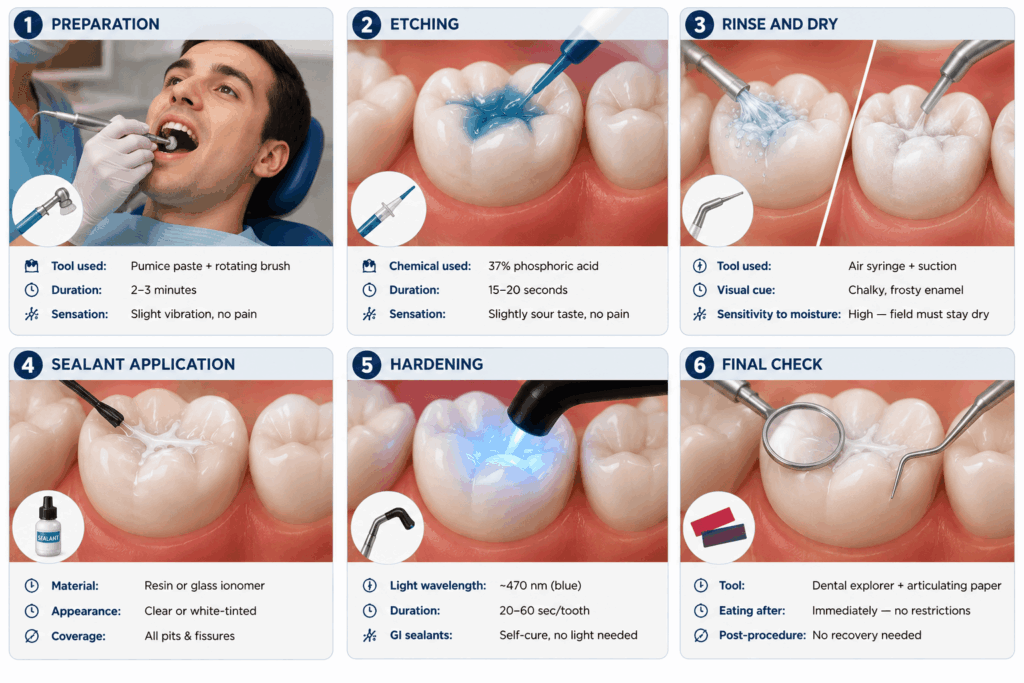
1. Preparation
The dentist or dental hygienist begins by thoroughly cleaning the tooth to remove plaque, food debris, and bacteria from the grooves. A special polishing paste is often used to ensure the surface is completely clean before the sealant is applied. Once cleaned, the tooth is rinsed and prepared for the next step.
- Tool used: Pumice paste + rotating brush
- Duration: 2–3 minutes
- Sensation: Slight vibration, no pain
2. Etching
Next, a mild acidic gel, called an etchant, is carefully applied to the chewing surface of the tooth for 15–20 seconds. This process slightly roughens the enamel at a microscopic level, creating a stronger bonding surface. The roughened texture helps the sealant securely attach to the tooth and improves its long-term durability.
- Chemical used: 37% phosphoric acid
- Duration: 15–20 seconds
- Sensation: Slightly sour taste, no pain
3. Rinse and Dry
After the etching process is complete, the gel is thoroughly rinsed away with water. The tooth is then completely dried using air or absorbent materials. Keeping the tooth dry is extremely important because moisture can interfere with proper sealant bonding and reduce the effectiveness of the treatment.
- Tool used: Air syringe + suction
- Visual cue: Chalky, frosty enamel
- Sensitivity to moisture: High — field must stay dry
4. Sealant Application
Once the tooth is clean and dry, the dentist applies the liquid sealant directly to the tooth’s pits and fissures of the tooth. The thin, flowable material spreads into the deep grooves where cavities commonly form.
- Material: Resin or glass ionomer
- Appearance: Clear or white-tinted
- Coverage: All pits & fissures
NOTE: If saliva touches the etched surface before the sealant is applied, the tooth must be re-etched entirely. Keeping the field dry is the single most critical technical step in the entire procedure.
5. Hardening
If a resin-based sealant is used, a special blue curing light is placed over the tooth for about 20–60 seconds to harden the material. This process quickly transforms the liquid sealant into a strong protective coating. Some sealant materials are self-curing and harden on their own without requiring a curing light.
- Light wavelength: ~470 nm (blue)
- Duration: 20–60 sec/tooth
- GI sealants: Self-cure, no light needed
6. Final Check
Finally, the dentist checks the hardened sealant to ensure all grooves are fully covered, and the bite feels comfortable. Any excess material or rough spots may be adjusted or polished for a smooth finish.
- Tool: Dental explorer + articulating paper
- Eating after: Immediately — no restrictions
- Post-procedure: No recovery needed
Each sealed tooth takes roughly 5 minutes to complete. The procedure is painless (no drilling or shots are needed, unless there are already cavities in need of a filling).
5 Key Benefits of Dental Sealants
Whether you are a parent considering pediatric sealants for your child or an adult exploring preventive options, here’s why this teeth sealing is worth it:
1. Cavity Prevention
Dental sealants create a physical barrier over the deepest pits and fissures of molars, the exact spots where bacteria and sugars accumulate and cause decay. These tiny crevices, often less than 0.1 mm wide, are narrower than a toothbrush bristle. Plaque and food debris accumulate there, the bacteria ferment sugars, produce acid, and the acid eats through the enamel. Because a toothbrush bristle is often too wide to fit into these grooves, the sealant effectively seals off the entry point.
According to the CDC, sealants prevent up to 80% of cavities in back teeth during the first two years after application, and continue to offer roughly 50% protection for up to four years. This makes them one of the highest-impact single interventions in preventive dentistry.
2. Easy Maintenance
A properly applied sealant provides durable, lasting protection, not a temporary fix. With good oral hygiene habits and regular dental checkups, resin-based sealants can remain intact and effective for 5 to 10 years. The ADA notes that when sealants are monitored at routine dental visits.
Any areas that have chipped or worn can be quickly and easily reapplied, restoring full protection within minutes. Glass ionomer sealants, while typically lasting 3–5 years, offer the additional benefit of continuous fluoride release that strengthens the surrounding enamel even after the visible material wears away.
3. High Clinical Effectiveness
The evidence base for sealants is extensive and consistently strong. Randomized controlled trials show substantially lower decay rates on sealed surfaces compared to unsealed controls. A study published on ResearchGate found that in a widely cited 2-year trial, 78.8% of sealed teeth remained completely cavity-free, while untreated teeth developed nearly three times as many cavities.
No other single preventive dental intervention produces comparable numbers at this cost level. In fact, ADA/AAPD guidelines recommend sealants on the primary molars of children and all permanent molars of children/adolescents to prevent and stop early decay.
4. Quick & Completely Painless
Unlike virtually every other dental restorative procedure, sealant application requires no drilling, injections, anaesthesia, or recovery time. The entire process for one tooth takes 5–10 minutes, and all four molars can typically be sealed in a single 30-to-40-minute visit. There is no discomfort whatsoever; patients feel only a brief air blast during drying and perhaps a slight sour taste from the etching gel.
This makes sealants exceptionally well-suited for children, who are far more likely to cooperate with a painless, non-invasive procedure than one involving needles or drills, building positive associations with dental care from an early age.
5. Safe & Biocompatible
A common parental concern is whether sealant materials are safe, particularly regarding BPA (bisphenol A), a compound found in some resins. The ADA has addressed this directly by stating that modern dental sealants have been extensively tested and that any BPA exposure from sealant placement is negligible, far below levels considered harmful and far lower than everyday BPA exposure from food packaging, receipts, or canned goods.
Both resin-based and glass ionomer sealants have been used safely in children for over 40 years, with no clinically significant adverse health effects documented in the peer-reviewed literature.
Dental Sealant Cost & Insurance Coverage
According to the CDC, school sealant programs can save up to $300 million by providing dental sealants to low-income children. These programs are especially cost-effective for children at high risk of tooth decay, with every sealed tooth saving more than $11 in future dental treatment costs.
| Scenario | Estimated Cost Per Tooth | Notes |
|---|---|---|
| Without insurance (child) | $30 – $60 | Most common range; varies by region |
| Without insurance (adult) | $30 – $80 | Slightly higher in some practices |
| With insurance (child) | $0 – $20 | Many plans cover 100% for children under 18 |
| With insurance (adult) | Variable | Some plans cover partially; check your policy |
| All 4 molars (no insurance) | $120 – $240 | Compared to $600–$1,200+ for 4 fillings |
| School-based programs | Free or low-cost | Available in many U.S. states for qualifying children |
NOTE: The prices mentioned above are only estimated averages and may vary depending on the dental clinic, location, dentist experience, insurance coverage, and the number of teeth being treated. It is always best to consult a licensed dental professional or your insurance provider for the most accurate and up-to-date pricing information.
Key Considerations to Remember
- Not covered by all adult dental plans
- Not appropriate if the tooth already has decay
- Require periodic monitoring and possible reapplication
- Not a substitute for brushing, flossing, and regular checkups
Tips to Make Your Sealants Last Longer
- Brush twice daily with fluoride toothpaste and floss daily. Sealants work best alongside good oral hygiene.
- Avoid chewing hard objects like ice, hard candy, or pen caps, which can chip the sealant.
- Reduce sugary and acidic drinks, which can degrade sealant material over time.
- See your dentist every 6 months so they can check the integrity of your sealants during routine exams.
- If you grind your teeth (bruxism), discuss a night guard with your dentist — grinding significantly shortens the lifespan of sealants.
| READ MORE: To learn more about the role of dental health in career growth and workplace confidence, read our detailed guide. |
|---|
Ready to Protect Your Teeth or Your Child’s?
Talk to your dentist at your next visit about whether dental sealants are right for you or your child. The procedure takes minutes, causes no pain, and can prevent years of costly dental work. Ask specifically about sealants on the first and second permanent molars, especially when those teeth have recently erupted.