Your dentist told you that you have periodontal disease. Now you are looking at treatment options, and your doctor has mentioned laser gum treatment.
You have questions. Is it actually better than traditional surgery? Will it hurt? How long is the recovery? Does insurance cover it?
Before we get into laser gum treatment, it helps to understand exactly what you are treating and why it matters beyond just your mouth.
What Is Periodontal Disease and Why Does It Matter?
Periodontal disease, also called gum disease, is a bacterial infection of the gums and the structures supporting your teeth. It starts as gingivitis, which is inflammation and bleeding of the gums, and progresses into periodontitis, where the infection begins destroying the bone and tissue holding your teeth in place.
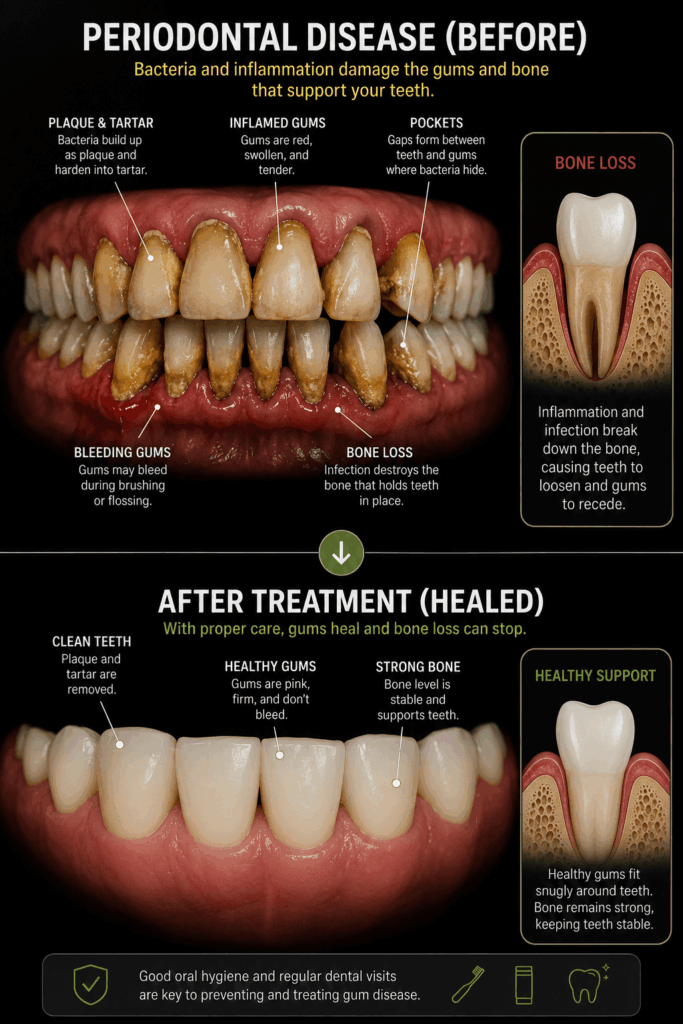
The National Institute of Dental and Craniofacial Research (NIDCR) Data Page, which explicitly states that 42.2% of US adults aged 30 or older have total periodontitis, with 7.8% having severe periodontitis.
Periodontal disease is also associated with increased risk of heart disease, diabetes, Alzheimer’s disease, and Parkinson’s disease. The bacteria that infect your gums do not stay in your mouth. They can enter your bloodstream and cause systemic damage throughout your body.
Here is the part most people do not realize: periodontal disease is largely painless in its early stages. You can have significant bone loss happening underneath your gums and feel almost nothing. By the time it becomes uncomfortable, the disease has often already progressed to a point where more intensive treatment is needed.
That is why regular dental checkups matter so much, and why treating periodontal disease early, before it reaches advanced stages, makes every treatment option more effective.
What Is Laser Gum Treatment?
Laser gum treatment, also called laser periodontal therapy, is a minimally invasive procedure that uses a specialized dental laser to remove infected gum tissue and bacteria from the pockets around your teeth, without the scalpel incisions and stitches used in traditional gum surgery.
The laser distinguishes between diseased and healthy tissue by color. The light in the laser is attracted to darker pigmentation, which is found in diseased tissue because of the blood-filled features characteristic of periodontal disease. The clinician uses the laser to vaporize unhealthy gum tissue and cauterize the treated area at the same time.
The most well-known form of laser gum treatment is called LANAP, which stands for Laser Assisted New Attachment Procedure. LANAP is the only laser periodontal therapy protocol that has received FDA clearance and is backed by peer-reviewed clinical research showing regeneration of bone and gum tissue around treated teeth.
Laser gum treatment works by using a specialized laser that emits a concentrated beam of light energy to remove infected gum tissue and bacteria from the pockets around the teeth. The laser targets only the diseased and inflamed tissue, leaving healthy tissue intact.
After the infected tissue is removed, the area is cleaned of plaque and tartar buildup, and the laser is used again to seal the treatment site, encouraging the body to form a natural clot and begin healing.
Traditional Gum Surgery vs. Laser Gum Treatment: What Is the Difference?
If your dentist has recommended treatment for periodontal disease, you may be weighing laser gum treatment against traditional surgical options. Here is a plain comparison.
| Factor | Traditional Gum Surgery | Laser Gum Treatment |
|---|---|---|
| Incisions | Yes, scalpel cuts required | No scalpel, no incisions |
| Stitches | Usually required | Rarely or never needed |
| Bleeding | More significant | Minimal, laser cauterizes as it works |
| Anesthesia | General anesthesia sometimes needed | Local anesthesia only |
| Recovery time | 2 to 4 weeks | A few days to about a week |
| Diet restrictions | Soft diet for weeks | Soft diet for a few days |
| Precision | Less precise, affects surrounding tissue | Targets diseased tissue only |
| Bone regeneration | Limited | Possible with LANAP protocol |
| Infection risk after | Higher | Lower, laser sterilizes as it goes |
| Pain during recovery | Significant | Mild for most patients |
Traditional periodontal surgery can cause swelling and discomfort and requires 2 to 4 weeks of recovery. Laser Assisted New Attachment Procedure (LANAP) only targets bacteria and diseased tissue, and surrounding healthy areas are left untouched, which dramatically reduces recovery time to only a couple of days.
Is Laser Gum Treatment Worth It?
For most patients with periodontal disease, yes, and here is why.
Untreated gum disease does not stay in your mouth. It progresses, destroys bone, loosens teeth, and connects to systemic conditions including heart disease, diabetes, and cognitive decline. The cost of not treating it is almost always higher than the cost of addressing it now.
Laser gum treatment offers a less invasive path to treating that infection with a faster recovery, less discomfort, and the potential for tissue regeneration that traditional surgery does not reliably produce.
The Benefits of Laser Gum Treatment
Here is a breakdown of what makes laser periodontal therapy worth considering over traditional approaches.
- Minimally invasive: The laser is precise and targets only the diseased tissue, leaving healthy gums intact. This results in less bleeding, swelling, and discomfort during and after the procedure.
- Faster recovery: Laser gum therapy offers a shorter recovery time than traditional surgery. The healing time for laser gum treatment lasts about a week on average, and some patients feel normal the day after the procedure. Compare that to 2 to 4 weeks of recovery with a scalpel-based approach.
- No general anesthesia needed: You will not need general anesthesia, which is sometimes required for other forms of dental surgery. Local anesthesia is used to numb the treatment area, and most patients are comfortable throughout.
- Reduced infection risk: The dental laser sterilizes the area during the procedure, reducing the risk of further infection after treatment.
- Promotes gum and bone regeneration: Laser therapy stimulates the growth of new, healthy gum tissue and can help in the regeneration of bone lost to periodontal disease. This is one of the most significant advantages over traditional surgery, which does not typically produce the same regenerative effect.
- Less dietary restriction: When lasers are used for periodontal treatment, the soft diet only needs to last a couple of days, and most patients feel healthy enough to resume eating right after treatment.
- Comfortable treatment experience: Laser gum treatment results in no bleeding, no sutures, mild irritation at most, no downtime, accelerated healing, and an excellent patient experience for the majority of people who undergo it.
Risks of Laser Gum Treatment for Periodontal Disease
Laser gum treatment is a safe, well-established procedure, but like any treatment, it helps to go in with realistic expectations. Here is what your dentist wants you to know.
| Consideration | What It Means for You |
|---|---|
| Results vary by case | Most patients see excellent improvement, though the extent of healing depends on how advanced your periodontal disease is when treatment begins. Your dentist will explain what to realistically expect for your specific situation. |
| Some cases need more than one session | Mild to moderate gum disease is often resolved in one or two visits. More advanced cases may benefit from a phased approach, treating one area at a time for the best results. |
| Provider experience matters | Laser gum treatment requires specific training, and dentists who offer it have undergone training to use lasers properly and understand how to apply the right technique. Choosing an experienced provider, like Dr Letha Robison at Robison Associates, ensures you get the full benefit of the technology. |
| Mild sensitivity is normal | Some patients notice mild tooth or gum sensitivity for a few days after treatment. This is a normal part of healing and typically resolves quickly on its own. |
| Insurance coverage can vary | Laser gum treatment is usually billed as a standard periodontal procedure, and many dental plans offer at least partial coverage. Our team is happy to help you check your benefits beforehand. |
| Good aftercare supports better results | Following your dentist’s aftercare guidance, sticking to a soft diet for a few days, and avoiding smoking helps your gums heal as quickly and fully as possible. |
Laser gum treatment requires specific training to use lasers correctly and apply the right technique. Dr Robison and our team are trained and experienced in laser periodontal therapy, so you are getting the full benefit of the technology, not a learning curve.
Some patients notice mild sensitivity for a few days after treatment. Our team provides clear aftercare instructions and is always a phone call away if you have any questions during healing.
What to Expect: A Step-by-Step Patient Guide to Laser Gum Treatment
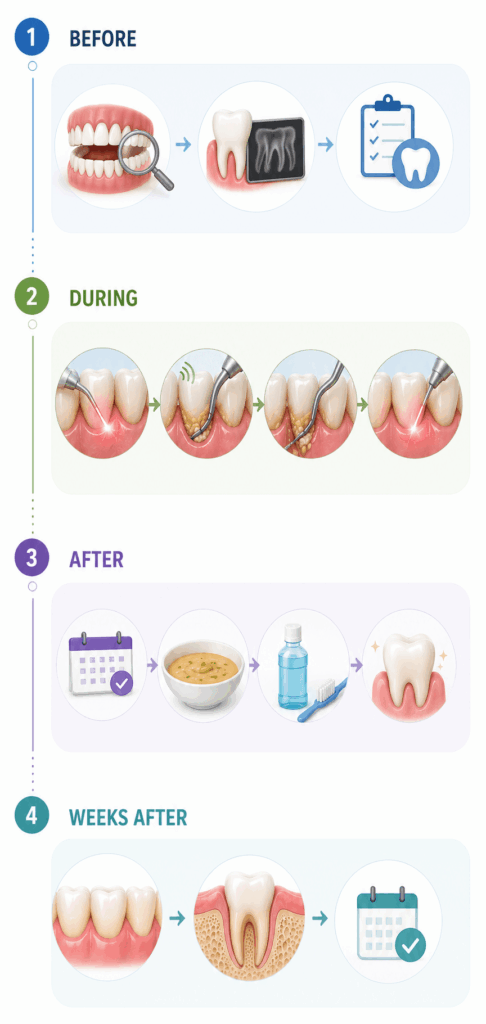
Before Your Appointment
Your dentist will first complete a thorough periodontal evaluation to assess the depth of the pockets around your teeth, the amount of bone loss present, and the extent of the infection. This determines whether laser gum treatment is the right approach and how many sessions you will need.
You will likely have X-rays taken and a full dental cleaning completed before your laser gum treatment appointment. In some cases, a deep cleaning called scaling and root planing may be done first.
Come to your appointment having eaten normally. You will be able to drive yourself home in most cases since only local anesthesia is used.
During the Procedure
You will be seated comfortably and the treatment area will be numbed with local anesthesia. Most patients feel no pain during the procedure itself.
The dentist uses a small fiber-optic laser tip, about the width of three human hairs, to enter the gum pocket alongside the tooth. The laser removes infected tissue and kills the bacteria present in the pocket without touching the healthy surrounding gum.
Next, any remaining plaque and tartar buildup is removed from the root surface using an ultrasonic scaler. The laser is then used again to seal the pocket, creating a stable clot that protects the area and allows healing to begin.
The procedure is quiet, precise, and for most patients, surprisingly comfortable.
After Your Appointment
You will likely have follow-up visits with your dentist to monitor your healing progress and ensure your gums are responding well to the treatment. These visits are also a good time to address any concerns or questions about your recovery and ongoing oral care.
Expect to follow a soft diet for a couple of days. Avoid hard, crunchy, or spicy foods while your gums heal. Do not smoke, as smoking significantly impairs gum tissue healing and undermines the results of laser periodontal therapy.
Use any prescribed rinse or medication as directed. Brush and floss gently around the treated area.
As your gums heal, you should notice a reduction in symptoms such as bleeding, swelling, and discomfort. Over time, with proper care and maintenance, laser periodontal therapy can lead to healthier gums, reduced pocket depths, and improved overall oral health. ]
The Weeks After Treatment
Most patients notice their gums looking and feeling healthier within one to two weeks. Gum tissue that was swollen and inflamed begins to tighten and reattach around the tooth. For patients who underwent the LANAP protocol specifically, some degree of bone regeneration around the treated teeth is possible over the following months.
Your dentist will schedule follow-up appointments to track your progress and ensure the disease has been successfully controlled.
How Many Sessions Will You Need for Laser Gum Treatment?
This depends entirely on the severity of your periodontal disease and how many teeth are affected.
Mild to moderate gum disease may be treatable in one to two sessions. More advanced or widespread disease may require multiple appointments, sometimes treating one quadrant of the mouth at a time to keep the procedure comfortable and manageable.
Your dentist will give you a clear treatment plan before you begin so you know exactly what to expect in terms of appointments, timeline, and cost.
Laser Gum Disease Treatment at Robison Associates Dentistry in Colorado Springs
At Robison Associates Dentistry, Dr Letha Robison offers laser gum disease therapy as a cornerstone of our approach to treating periodontal disease in Colorado Springs.
We use soft-tissue laser technology because our patients’ comfort is not an afterthought. It is the foundation of how we practice. Lasers sterilize gum tissue, disinfect the pockets between your teeth, and dramatically reduce the bleeding and tenderness that make traditional gum surgery so difficult to recover from.
Every patient who comes to us with gum disease receives a thorough periodontal evaluation first. We assess the extent of the infection, explain every option available to you, and build a treatment plan that fits your specific situation, not a generic protocol.
Contact us online to schedule your evaluation. Healthy gums are the foundation of a healthy smile, and treating periodontal disease now protects both.