

Key Takeaways
- Waiting makes it worse — a small cavity becomes a costly root canal if ignored.
- No pain — numbing ensures you feel pressure only, never pain.
- 45–60 minutes — most patients return to work the same day.
- Material matters — composite for looks, ceramic for longevity, gold for grinders.
- Act today — the cheapest, simplest version of this fix is always right now.
“Will it hurt? Can I even afford this? Have I already waited too long?”
If these are the questions keeping you up at night, you’re in the right place.
It’s summer. Everyone’s enjoying cold ice cream, iced drinks — and you’re avoiding them because you know what happens when cold hits that tooth.
That dull throb at 2am. The painkiller. The promise to make an appointment with the dentist. Then tomorrow comes and life gets in the way again.
Until the next night.
Your tooth is asking for help. And every time you delay, it asks a little louder.
This guide answers everything — honestly, simply, and in plain English.
Let’s talk about what happens next.
Quick Answer
A dental filling removes the decayed part of your tooth and seals it — stopping the damage from spreading. It takes 45–60 minutes, you feel no pain during the procedure, and you can go back to your normal day right after. The longer you wait, the bigger the problem gets — and the more it costs to fix.
Signs You Might Need a Dental Filling
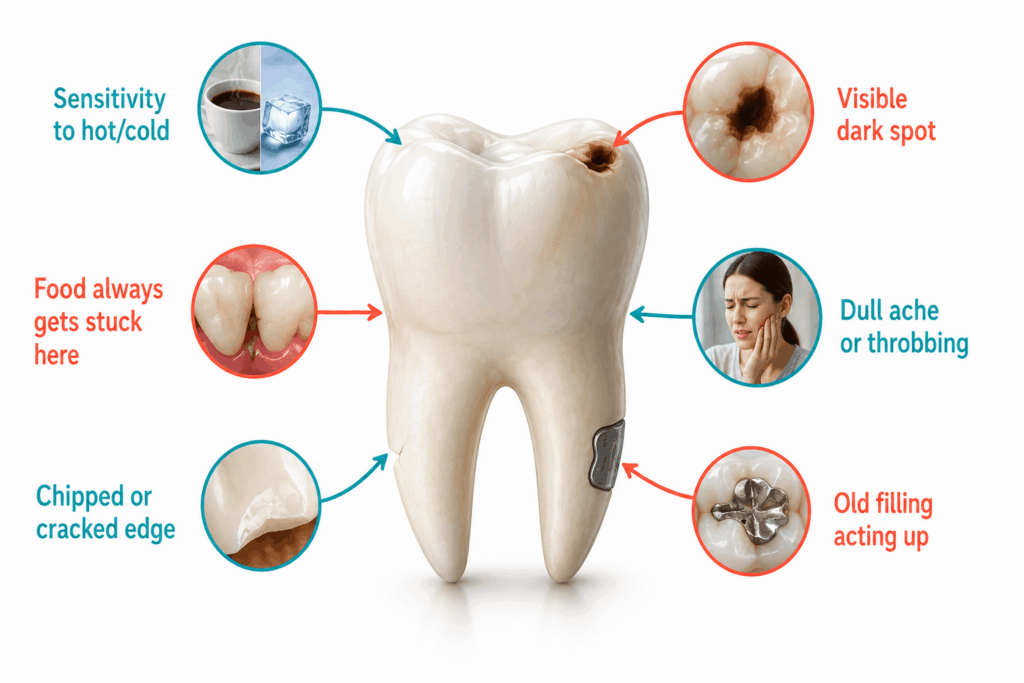
Not sure if that tooth twinge is serious? Here are the most common warning signs. The sooner you act, the simpler — and cheaper — the fix.
- Sensitivity to hot or cold
A sharp zing when you sip coffee or eat ice cream is often your first clue.
- Persistent toothache
A dull ache or throbbing that doesn’t go away after a day or two.
- Visible dark spot or hole
A discolored area or a small pit you can feel with your tongue.
- Food always gets stuck
If food is consistently caught between two teeth in the same spot, decay may be starting.
- Chipped or cracked tooth
Teeth that grind (bruxism) or take a knock can chip — a filling rebuilds what’s lost.
- Old filling feels loose
Fillings don’t last forever. Cracks or sensitivity in an old filling means it’s time for a replacement.
Colorado Springs tip: If you’re noticing any of these signs, getting a filling now is far simpler — and far less expensive — than waiting until you need a root canal. Schedule your visit at Robison Dental.
Types of Dental Fillings Which One Is Right for You?
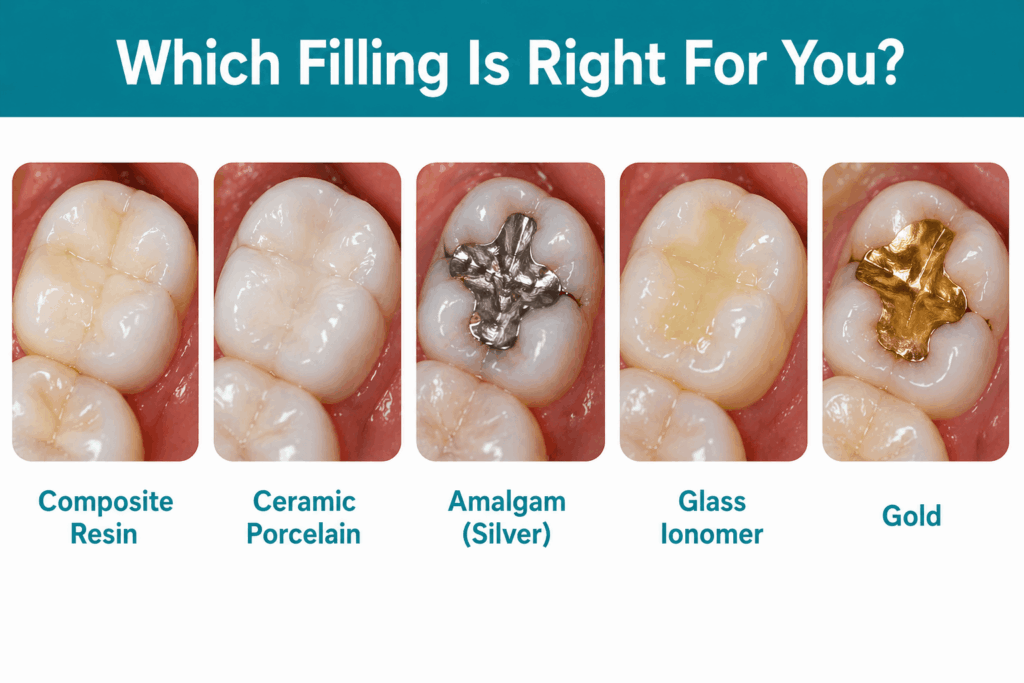
Fillings aren’t one-size-fits-all. The best choice depends on where the cavity is, how large it is, and what matters most to you — appearance, durability, or cost.
Our General Dentistry services include natural-looking, tooth-colored restorations placed after decay removal — sometimes using laser, which means no anesthetic needed.
| Filling Type | Appearance | Best For | Avg. Cost* |
|---|---|---|---|
| Composite
(Recommended) |
Tooth-colored | Front & back teeth, small–medium cavities | $150–$300 |
| Ceramic | Tooth-colored, stain-resistant | Best cosmetic result | $250–$450 |
| Amalgam | Silver / visible | Large back-molar cavities | $75–$150 |
| Glass Ionomer | Tooth-colored (less precise match) | Children, near gumline | $100–$200 |
| Gold | Gold / visible | Maximum durability, bruxism patients | $400–$800 |
US national averages per tooth surface. Actual cost varies by location, number of surfaces, and insurance coverag
The Dental Filling Procedure — Step by Step
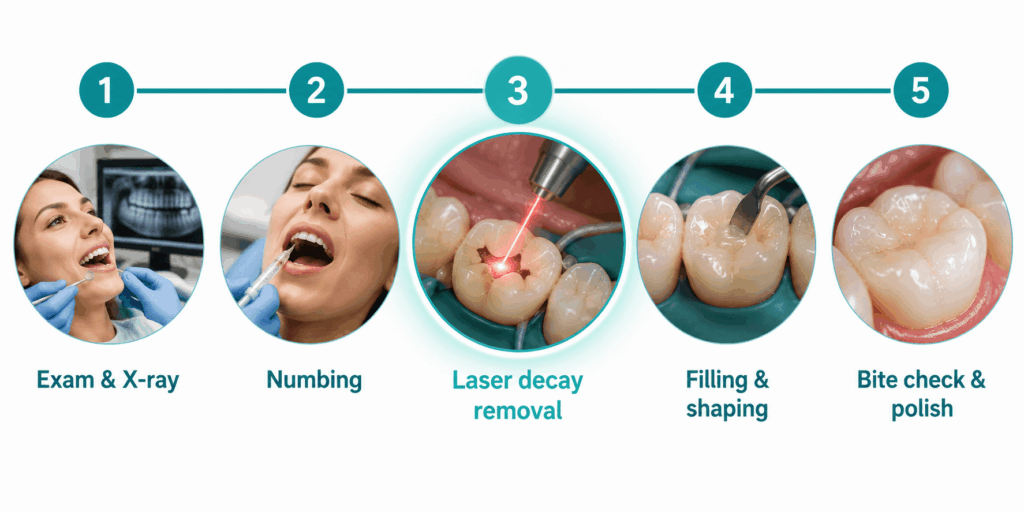
Worried about what happens in the chair? Here’s exactly what to expect. Click each step to read more.
Exam & X-Ray
About 5–10 minutes
Your dentist examines your tooth and takes an X-ray if needed to see how deep the decay goes. This tells them exactly which filling material is best for you. The X-ray is quick and completely painless.
At Robison Dental We use digital X-rays that emit up to 80% less radiation than traditional film and show results instantly on screen — so you can see exactly what we see.
Numbing the Area
About 5 minutes
Your dentist applies a topical gel to the gum first, then a small injection of local anesthetic. The injection is the part most people worry about — but the topical gel means you’ll feel very little. Within minutes, the tooth and surrounding area are completely numb.
Our all-female team takes time to check in with you before and during this step. Warm blankets and neck pillows are always available if you need extra comfort.
Removing the Decay
About 10–20 minutes
The dentist removes the decayed tissue. Most offices use a dental drill. If all decay isn’t removed, it will continue under the filling — so this step is done carefully. You’re completely numb, so there’s no pain, only some pressure and vibration.
We offer laser-assisted decay removal — quieter than a drill, more precise, and preserving more healthy tooth structure. Many anxious patients find laser dentistry much easier to tolerate.
Placing the Filling
About 10–15 minutes
The filling material is placed in layers (for composite) or as a single piece (for amalgam). Each layer of composite is hardened with a special curing light in seconds. The dentist shapes the material to match your natural tooth exactly.
Tooth-colored composite: Dr. Robison matches the shade of the filling to your natural tooth before placing it, so the result looks completely seamless when you smile.
Bite Check & Polish
About 5 minutes
You’ll bite down on special paper to check that the filling doesn’t sit too high. Any high spots are trimmed and polished smooth. You leave the office with a tooth that feels natural — and a smile that looks exactly the same.
Total chair time: 45–60 minutes. Most patients return to work the same day. No recovery needed.
The honest answer to “does a filling hurt?” — You’ll feel pressure and vibration, but no pain. The numbing injection is the most uncomfortable part, and most patients say it’s far less scary than they expected. If you have dental anxiety, tell us — we adjust everything to make you comfortable.
How Long Do Dental Fillings Last?
The lifespan of a filling varies by material, your oral habits, and where the filling sits in your mouth. Here’s a quick visual:
| Filling | Lifespan |
|---|---|
| Composite (tooth-colored) | 5–10 years |
| Ceramic (porcelain) | 10–15 years |
| Amalgam (silver) | 10–15 years |
| Glass Ionomer | 3–5 years |
| Gold | Up to 30 years |
According to the National Institute of Dental and Craniofacial Research, proper oral hygiene and regular dental visits are the single biggest factors in how long a filling lasts. Research published also confirms that material selection and placement technique significantly impact longevity.
Factors that shorten a filling’s life:
- Teeth grinding (bruxism) wears fillings down faster than normal chewing. Ask doctor about a custom night guard.
- Poor oral hygiene — new decay can form at the edges of a filling, loosening it.
- Location — back molars take more chewing force, so fillings there wear faster.
- Hot/cold cycling — if a filling material expands and contracts with temperature changes, cracks can develop over time.
Signs your filling needs replacing:
- Sensitivity returns after years of feeling fine
- You can see a crack or feel a rough edge with your tongue
- The filling feels loose or higher than the surrounding tooth
- Food is getting stuck near an old filling again
If you notice any of these, schedule a check-up — catching a failing filling early prevents a bigger problem. We also include a thorough Oral Cancer Screening as part of every comprehensive exam.
How Much Does a Dental Filling Cost?
Filling costs depend on the material, the number of tooth surfaces involved, and your insurance coverage. Here are national averages to give you a realistic idea:
| Type | Cost | Notes |
|---|---|---|
| Composite | $191 avg / $100–$400 | Most popular, tooth-colored |
| Ceramic / Porcelain | $1,150 avg / $500–$2,800 | Best aesthetics, stain-resistant |
| Amalgam | $160 avg / $100–$350 | Most affordable, back molars |
| Gold | $400 avg / $250–$650 | Longest lasting, most durable |
Note: Actual costs vary by location, cavity size, and insurance coverage. Contact Robison Dental for a personalised estimate.
What affects the final price?
- Number of surfaces — a cavity touching two surfaces of a tooth costs more than one on just one surface.
- Location — a back molar filling is typically more complex than a front tooth.
- Insurance — most plans cover amalgam fully; composite is often partially covered (50–80%). Check your plan before your appointment.
- Financing — Robison Dental offers payment options so cost never has to delay your care.
The bottom line: A composite filling today is one of the most affordable dental procedures there is. A root canal — what happens when a cavity is left untreated — costs several times more. The cheapest day to fix your tooth is always today.
After Your Filling — What to Expect & How to Care for It
Most patients leave our office feeling completely fine. Here’s what’s normal, and what to watch for.
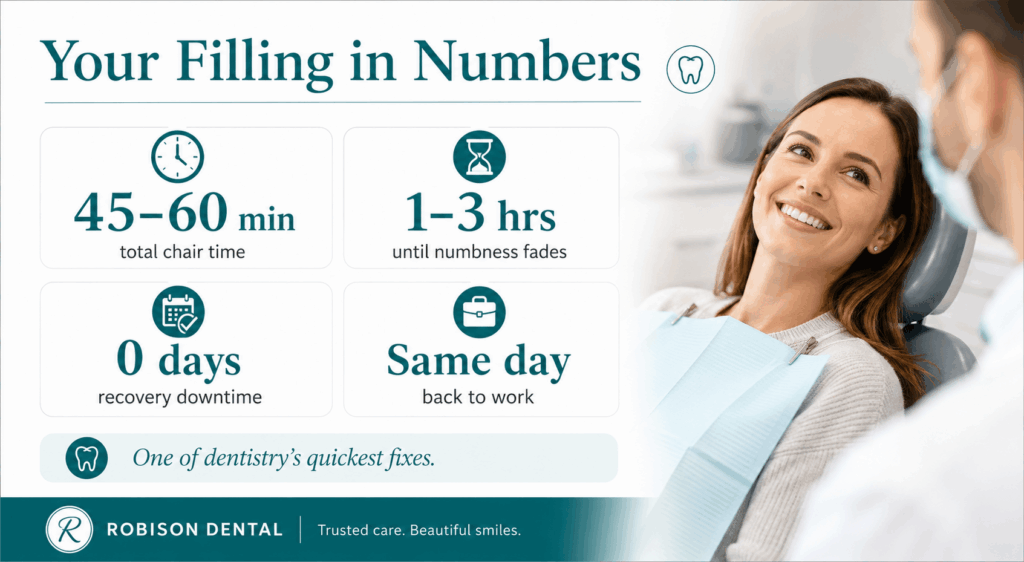
Your first 24 hours — a timeline
- Right now
Composite filling? Already set. The curing light hardened it before you left the chair. You’re good.
- First 1–3 hours
Still numb — skip the snacks. Avoid eating until the numbness wears off so you don’t accidentally bite your cheek or tongue.
- Numbness gone
Composite patients: eat normally. Amalgam patients: soft foods only for 24 hours while the filling fully hardens.
- First few days
Some sensitivity to hot and cold is completely normal. It fades on its own. If it persists beyond a week, call us.
Long-term care to make your filling last
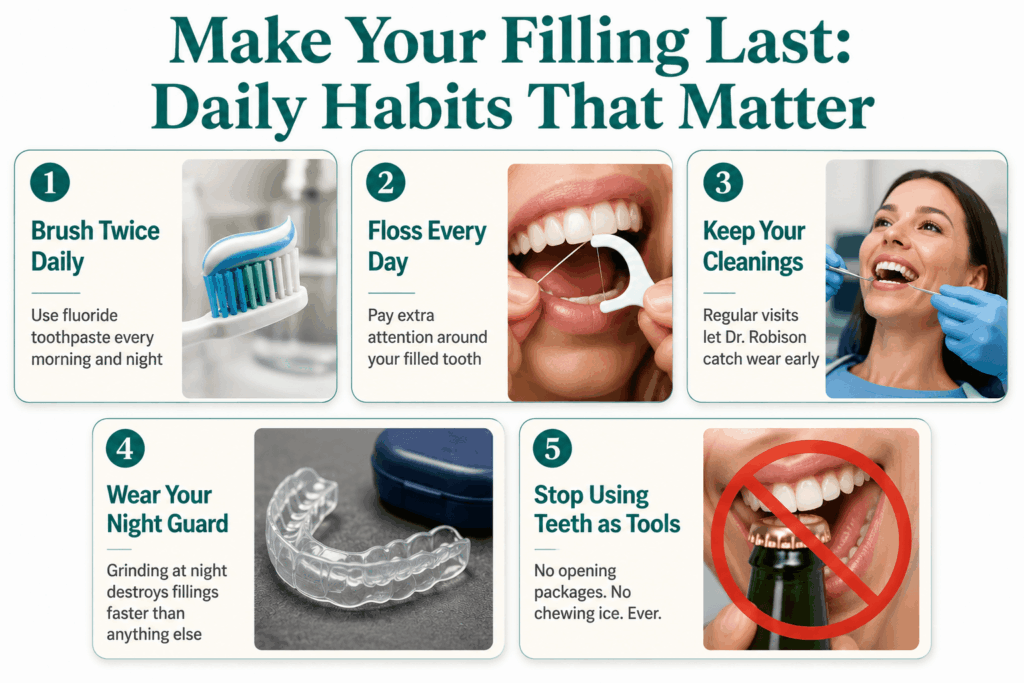
- Brush twice a day with fluoride toothpaste
- Floss daily — especially around filled teeth
- Attend regular cleanings so Dr. Robison can monitor the filling
- If you grind your teeth, wear your night guard every night
- Avoid using your teeth as tools (opening packages, chewing ice)
Busy professional? Most patients return to work the same afternoon. There’s no downtime, no swelling, and no dietary restrictions beyond the first day. A filling is one of dentistry’s quickest fixes.
Final Thoughts
A dental filling is the simplest fix in dentistry — 45 minutes, no pain, same day back to work. This guide covers everything Colorado Springs patients need to know: six warning signs you shouldn’t ignore, five filling types with honest costs, a step-by-step procedure walkthrough, how long each material actually lasts, and exactly what to do after. Whether it’s your first filling or your fifth — the answer is always the same. The sooner you go, the simpler it stays.
Your Tooth Has Been Asking. This Is You Finally Listening.
The fear, the cost worry, the “I’ll do it next week” — we’ve heard it all. And we understand. But here’s what every patient tells us after: “I wish I hadn’t waited so long.”