
Summary:
Dry socket (also called alveolar osteitis) is a painful complication that can happen after a tooth is pulled. It occurs when the protective blood clot at the extraction site is lost or fails to form, leaving bare bone and nerve endings exposed to air, food, and bacteria.
It affects 2 to 5 percent of all tooth extractions and up to 30 to 45 percent of impacted wisdom tooth removals (Cleveland Clinic, 2025). It is treatable, usually heals within 7 to 10 days with professional care, and is rarely life-threatening. But it is one of the most painful dental complications a person can experience.
There is a very specific kind of panic that hits on Day 3 after a tooth extraction.
The first two days were rough, sure. But manageable. Then, just when things should have been getting better, the pain comes back harder.
If this sounds familiar, you might be suffering from dry socket.
Dry socket, medically known as alveolar osteitis, is a painful complication that can develop after a tooth extraction.
This guide covers everything: what dry socket is, what it looks like, symptoms, how to treat, and exactly when to see a dentist for dry socket.
What Is Dry Socket?
Every time a tooth is extracted, the body immediately gets to work. Within the first few hours, a blood clot forms inside the empty hole in the jawbone. That hole is called the socket.
The clot is not just a side effect of the procedure. It acts as a natural bandage, protecting the exposed bone and nerve endings underneath while your body grows new tissue to seal the wound.
In dry socket, that clot either:
- Never forms properly
- Gets dislodged too early (by suction, rinsing, or physical disruption)
- Dissolves before the socket has healed
Without the clot, bare bone and raw nerve endings are left exposed to air, food, bacteria, and saliva. That exposure causes the severe, radiating pain that defines dry socket.
This guide covers everything: what dry socket is, what dry socket looks like, symptoms, how to treat, and exactly when to see a dentist for dry socket.
The numbers:
- Dry socket affects approximately 2–5% of all tooth extractions
- For impacted wisdom teeth, the risk jumps to 25–45%
- Smokers are more than 3 times more likely to develop dry socket than non-smokers
- It occurs 10 times more often in the lower jaw than the upper jaw
What Does Dry Socket Look Like?
This is where most people end up searching at 11 p.m., flashlight in hand, squinting at the mirror.
Here is exactly what dry socket looks like versus what normal healing looks like:
Normal Healing: What to Expect
In the first 24 to 48 hours after extraction, a dark reddish or maroon clot should be visible inside the socket. It looks wet and slightly sunken. As days pass, it may lighten in color to a pinkish white as new gum tissue begins to grow over it. Some yellowing or white tissue forming at the edges is completely normal. That is called granulation tissue and it means healing is underway.
Dry Socket: What to Look For
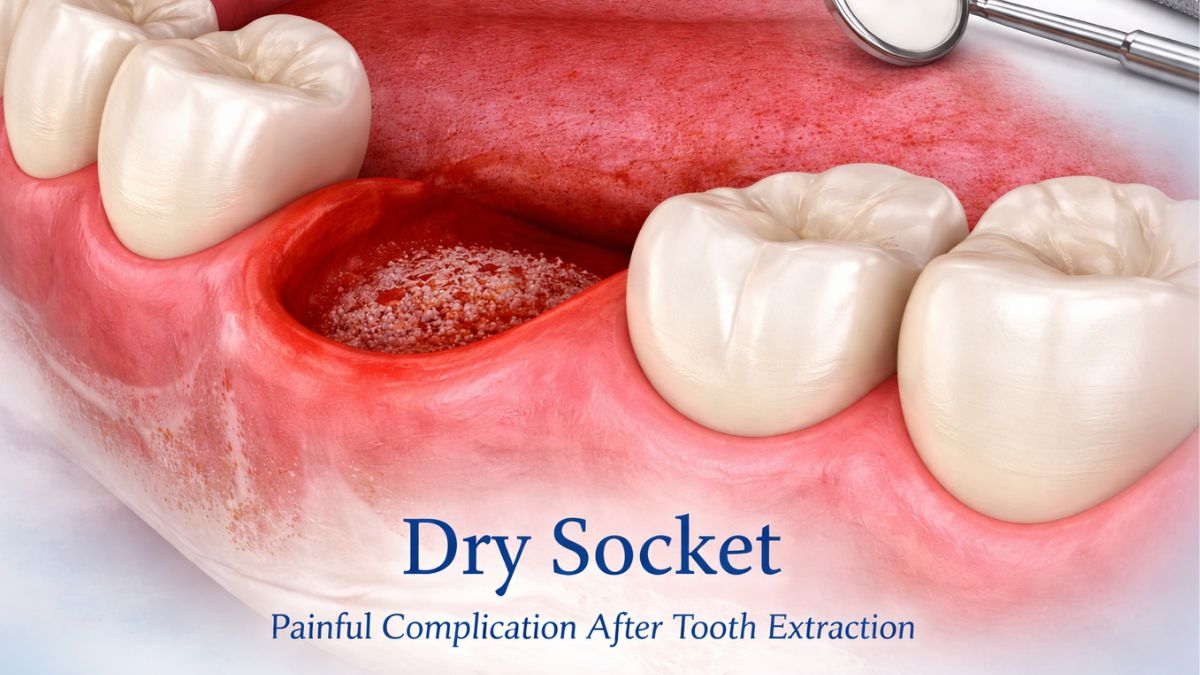
Instead of a dark, moist clot, the socket looks empty. The bottom of the hole may appear whitish, yellowish, or even grayish because what is visible is not a clot. It is bone. Raw, exposed jawbone.
What this actually looks like:
- An empty-looking hole where the tooth used to be
- Exposed white or yellowish bone at the bottom of the socket, instead of a dark clot
- The surrounding gum tissue may look red, swollen, or irritated
- The socket appears dry, hence the name
- There may be visible food debris trapped in the unprotected hollow
Dry Socket Symptoms: What Does It Feel Like?
Dry socket has a very specific and recognizable pain pattern. Here’s how to identify it:
The Signature Symptom: Pain That Gets Worse
After any extraction, pain is expected. But normal post-extraction pain follows a predictable downward curve. It hurts most on Day 1, eases by Day 2, and continues improving through the first week.
Dry socket breaks that pattern. Pain escalates around Days 2 to 4. Instead of waking up feeling better, the pain is sharper, more persistent, and harder to control. That reversal is the clearest signal that something has gone wrong.
Full List of Dry Socket Symptoms
- Severe, throbbing pain at the extraction site that intensifies after Day 2
- Radiating pain spreading to the ear, temple, eye, or neck on the same side of the face
- Visible bone inside the socket instead of a dark clot
- Bad breath (halitosis) that does not improve with gentle rinsing
- A foul or unpleasant taste in the mouth
- Little to no relief from over-the-counter pain medication like ibuprofen or acetaminophen
- An empty-looking socket with no dark clot visible
- Low-grade fever in some cases, especially if infection has developed alongside the dry socket
How Painful Is Dry Socket, Really?
How painful is dry socket? Very. Harvard Health Publishing describes it as one of the most painful complications in dentistry (Harvard Health, 2025). Patients consistently rate the pain as moderate to severe on clinical pain scales, with many reporting it as more painful than the extraction itself.
The pain is constant, throbbing, and radiating. Over-the-counter medications provide little to no relief for most people, which is actually one of the clearest diagnostic signals that this is dry socket rather than normal recovery soreness.
Most people describe it as a deep, aching throb that seems to pulse outward from the socket into the surrounding jaw, then into the ear, then into the neck. It is not a sharp pain that comes and goes. It is a constant, heavy ache that refuses to let up.
Early Stage Dry Socket: The Critical First Three Days
Early-stage dry socket is the most important concept for anyone currently in recovery from a tooth extraction. The earlier this is caught and treated, the faster the relief and the better the outcome.
Here is a day-by-day breakdown of what to expect and which warning signs should not be ignored:
| When | What Happens |
|---|---|
| Day 1 | Some bleeding, throbbing, and swelling is completely normal. A blood clot should form within hours. Pain should be manageable with prescribed or OTC medication. WARNING: Heavy, uncontrolled bleeding that does not respond to gauze pressure needs immediate attention. |
| Day 2 to 3 | This is the highest risk window. Pain should be declining, not staying the same and especially not increasing. The socket may look different as the clot matures. WARNING: Pain that suddenly spikes, radiates to the ear or jaw, or any moment where looking in the mirror reveals an empty, pale socket instead of a dark clot. |
| Day 4 to 5 | If pain has been consistently improving, the risk window is largely passing.
WARNING: Any sudden return of worsening pain after previous improvement is a red flag, even at this stage. |
| Day 5 onward | After Day 5 without significant worsening symptoms, the dry socket risk drops dramatically. The socket should be visibly filling in with new tissue. The risk is considered essentially passed by most oral surgeons. |
The most important thing to know about early-stage dry socket:
The risk window is Days 2 to 3 post-extraction. That is when most cases develop. If Day 5 arrives with no significant worsening of pain and no visible bone in the socket, the crisis has almost certainly passed. But if pain worsens at any point before then, do not wait. Call a dentist that same day.
Still Not Sure If It Is Dry Socket?
That uncertainty at 2 a.m., checking the mirror for the fifth time, genuinely not knowing if something is wrong or if this is just how recovery goes… that is an awful place to be.
The team at Robison Associates, based in Colorado Springs, has seen this scenario hundreds of times. A five-minute call or same-day visit is all it takes to get a clear answer and, if needed, treatment that brings real relief within hours.
Do not sit with the uncertainty. Visit robisondental.com or call the office today.
Dry Socket vs Normal Healing: A Side-by-Side Comparison
The most common question after a tooth extraction is not really about dry socket in the abstract. It is personal: Do I have it? Here is a direct, honest comparison of dry socket vs normal healing so that the question can finally be answered.
| Normal Healing | Dry Socket | |
|---|---|---|
| Pain pattern | Improves gradually each day | Gets WORSE after Day 2 to 3 |
| Pain level | Manageable with OTC medication | Severe, OTC meds provide little relief |
| Pain radiation | Stays near the extraction site | Spreads to ear, temple, jaw, or neck |
| Socket appearance | Dark red or maroon clot is visible | Empty, whitish, or pale bone visible |
| Smell and taste | Normal or mild metallic | Foul odor and persistent bad taste |
| Gum tissue | Gradually closing and pink | Swollen, red, inflamed |
| OTC pain med response | Provides adequate relief | Little to no relief |
| Fever | Not present | Possible low-grade fever |
| Onset of concern | Not applicable | Days 2 to 5 post-extraction |
Wisdom Tooth Blood Clot vs. Dry Socket
After wisdom tooth removal, understanding wisdom tooth blood clot health versus dry socket is especially important because the risk is significantly higher.
Blood clots in wisdom teeth sockets form the same way as any extraction: a dark, moist, clot-filled mass in the socket is the goal. That is what wisdom socket healing should look like in the first few days.
If instead the socket appears pale, empty, or bony, and the pain is radiating rather than receding, that is not normal wisdom socket healing. That is a dry socket in need of treatment.
For context: while blood clots in wisdom teeth sockets follow the same biology as other extractions, the risk of dry socket after impacted wisdom tooth removal can reach 25 to 45 per cent compared to just 2 to 5 per cent for standard extractions.
What Causes Dry Socket? Risk Factors Worth Knowing
Researchers at the National Library of Medicine note that the exact mechanisms of dry socket are not yet fully understood. What is known is that certain behaviors and biological factors significantly raise the odds.
Behavioral Risk Factors (The Ones People Control)
- Smoking or tobacco use is the single biggest controllable risk factor. Smokers are over 3x more likely to develop dry socket. Chemicals in tobacco impair healing, and the physical act of smoking creates suction that can dislodge the clot.
- Drinking through a straw creates the same suction mechanics as smoking. Even a single use can be enough to dislodge a clot that is only partially formed.
- Vigorous rinsing or spitting can physically pull the clot loose. The force needed to swish water hard or spit is more than enough to disrupt the fragile clot in the first 24 to 48 hours.
- Touching or probing the socket with a finger, tongue, toothpick, or any other object.
Medical and Individual Risk Factors
- Hormonal birth control (estrogen) elevates estrogen levels, which have been shown to accelerate the breakdown of blood clots (a process called fibrinolysis). Patients on oral contraceptives should inform their dentist before any extraction, so appropriate precautions can be taken.
- Poor oral hygiene means more bacteria are already present in the mouth, which can interfere with proper clot formation or degrade the clot faster than normal.
- Pre-existing tooth or gum infection near the extraction site raises the risk by introducing bacteria directly into the healing environment.
- Blood thinners or anticoagulant medications can interfere with normal clotting.
- Dense bone structure in the lower jaw is one reason why dry socket is 10 times more common in the mandible than the maxilla.
Procedure Related Factors
- Difficult or traumatic extraction, especially impacted wisdom teeth, causes more tissue trauma and makes stable clot formation harder.
- Longer operative time correlates with higher dry socket risk due to increased tissue disruption.
- Lower jaw extraction carries an inherently higher risk due to denser bone and different blood supply characteristics.
How to Treat Dry Socket: What Your Dentist Does
Dry socket must be treated professionally. You cannot cure it at home, and you should not try to wait it out if the pain is severe.
Here is exactly what happens when you see a dentist for dry socket:
Step 1: Diagnosis
Your dentist examines the socket visually and asks about your pain history (onset, severity, radiation). In some cases, an X-ray is taken to rule out remaining bone fragments or other complications.
Step 2: Cleaning the socket
The dentist gently flushes (irrigates) the socket with sterile saline or an antibacterial rinse to remove food debris, bacteria, and any remaining breakdown products from the lost clot.
Step 3: Medicated dressing (the key treatment)
The socket is packed with a medicated dressing, typically containing eugenol (oil of cloves), which has a natural anesthetic and anti-inflammatory effect. This dressing:
- Protects the exposed bone from air and debris
- Provides significant pain relief; many patients report a 50% reduction in pain within hours of the first dressing
- Allows new tissue to begin forming underneath
Step 4: Follow-up visits
You will likely return every 1–3 days for the dressing to be changed. Most patients require 2–4 visits total. Each visit, the dentist reassesses healing and refreshes the medicated packing.
Step 5: Pain management
Your dentist may recommend:
- Ibuprofen + acetaminophen together. This combination rivals prescription opioid pain relief
- Prescription pain medication in severe cases
- Antibiotics only if there is a confirmed infection (dry socket itself is not an infection — antibiotics do not treat dry socket without infection)
Newer treatments (2025):
- Platelet-Rich Fibrin (PRF)
A biologic therapy using the patient’s own blood to create a growth-factor-rich membrane placed in the socket. A 2024 systematic review in the International Journal of Oral and Maxillofacial Surgery found PRF reduces pain and speeds healing significantly.
- Low-level laser therapy (LLLT)
Some practices now offer this to reduce inflammation and promote tissue regeneration.
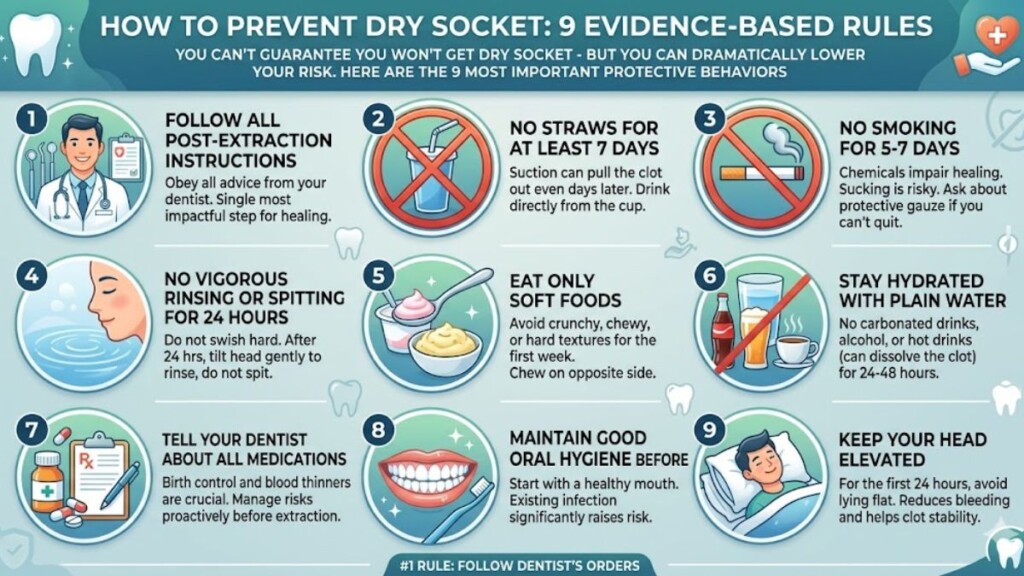
How to Prevent Dry Socket: 9 Rules That Actually Work
Knowing how to prevent dry socket and how to avoid dry socket comes down to one central goal: protect the blood clot at all costs during the first five to seven days. Everything on this list serves that goal.
When to See a Dentist for Dry Socket
Knowing when to see a dentist for dry socket is not complicated. The threshold should be low. The treatment is quick, the relief is significant, and waiting only prolongs suffering.
See a Dentist as Soon as Possible If:
- Pain is worsening after Day 2 to 3 rather than declining
- Pain is radiating to the ear, jaw, temple, or neck on the same side as the extraction
- The socket looks empty, pale, or bony instead of showing a dark clot
- A foul taste or bad breath persists even after gentle rinsing
- Over the counter pain medication is providing little to no relief after the first 48 hours
Go to Urgent Care or an Emergency Dental Clinic If:
- Pain is severe enough to prevent sleep or normal functioning and the regular dentist cannot be reached
- Significant facial swelling appears alongside fever, which may indicate spreading infection
- Pus, increasing swelling beyond the immediate jaw area, or chills are present
Pain Is Real. So Is Relief. Robison Dental Can Help.
Dealing with post-extraction pain that just will not quit is exhausting. Worrying about whether something is seriously wrong makes it worse.
The team at Robison Dental understands that coming back to the dentist after an extraction feels like admitting defeat. It is not. It is simply good patient care, and getting treated early makes everything faster and less painful.
Whether it is a same-day appointment to check on a suspicious socket or a full dry socket treatment with a medicated dressing, Robison Dental provides compassionate, efficient care without judgment.
Book a same-day or next-day appointment at Robison Associates and get the relief that is overdue.